Oryoki Instruction
The Meal Ceremony
The Japanese word ‘oryoki’ means roughly, ‘that which contains just enough’, and refers to the set of eating bowls that Zen monks or nuns receive at their ordination. Oryoki practice is a way of extending our meditation into the meals during a retreat. It is a monastic tradition over a thousand years old, and most people who try it come to deeply appreciate its elegance and simplicity. You receive and eat your food, and then clean up afterwards, while remaining on your meditation cushion. This is an outline of how practice oryoki with Castlemaine Zen.
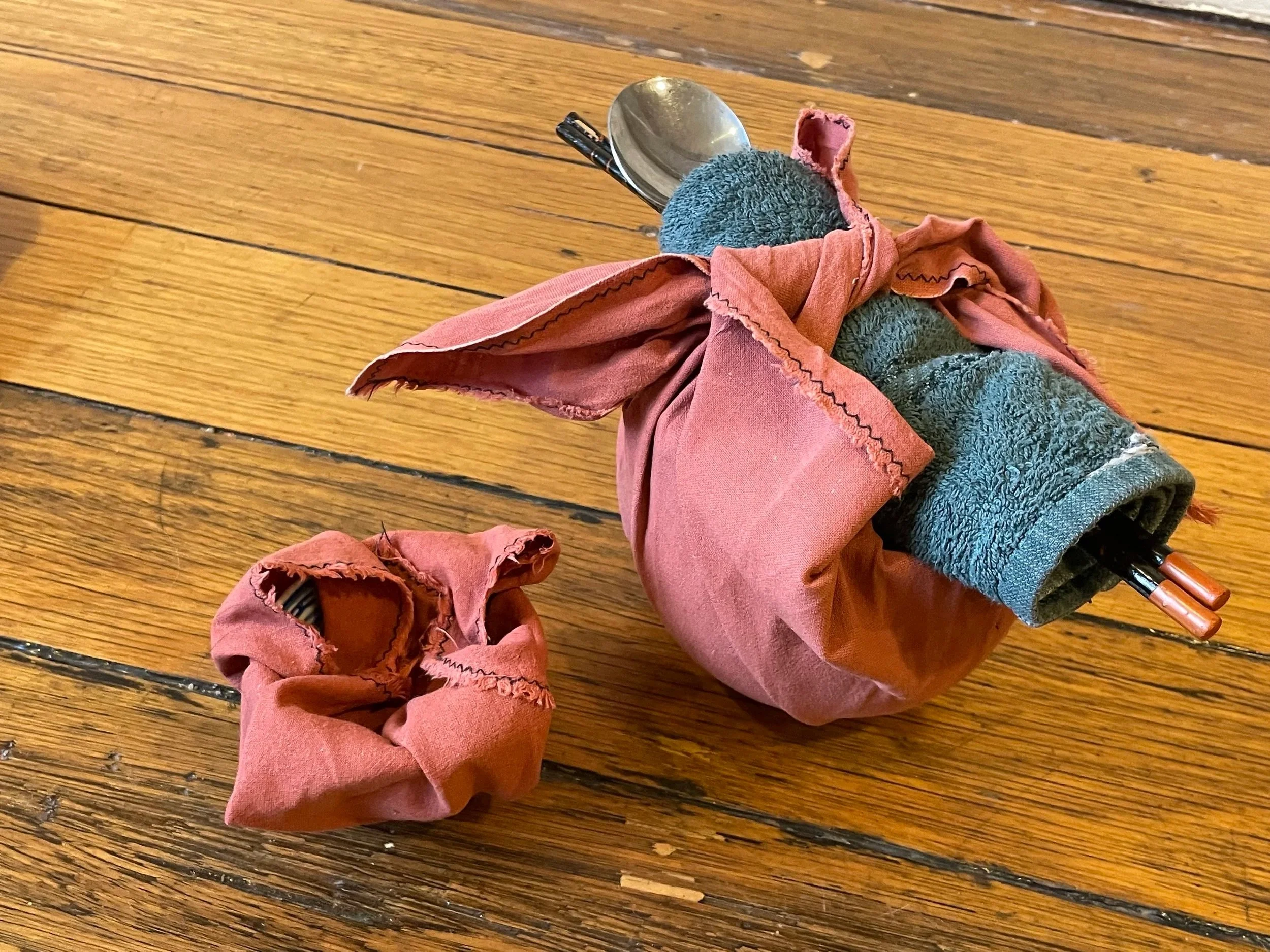
An oryoki set includes three nesting bowls, chopsticks, a spoon, a napkin (also used as a dishcloth) and a cloth to wrap everything in (which also serves as a placemat). To assemble it at the start of a retreat, spread the placemat in a diamond shape. Place the three nested bowls in the centre. Fold the top and bottom corners of the placemat over the bowls. Roll your utensils in the napkin and place it on top of the bowls. Fold the two remaining corners of the placemat over the whole thing and tie like a kerchief. The set is stored, along with a chant card (a copy of the sutras that are chanted before and after meals) against the wall, at your place in the dojo. At some retreats a separate dining room is used, and your bowl and sutra card are kept at your particular place at table.
An oryoki meal has eight main parts:
Opening the oryoki set.
Receiving food from the servers.
Making a food offering.
Chant of gratitude.
Eating.
Cleaning the bowls with tea.
Making a tea offering.
Packing up the oryoki set.
Opening the Oryoki Set
After the first chant, lay out your set so that it ends up looking something like this. Spread the placemat in a diamond shape and then tuck the four corners underneath as shown. Put your napkin in your lap.
Receiving Food from the Servers
During the second chant (‘Vairochana’), the servers bring food in on trays and in pots. Any time a server is in front of you, gassho until the server has moved on. Serve yourself from the tray and slide it down the line; hand your bowl to the server for food from the pots, remaining in gassho. To indicate that you have been served enough food, hold palms horizontally and sweep one briskly across the surface of the other. If you require a larger helping, indicate this by holding the palms horizontally and gently rubbing them together with a circular motion. If there are condiments, use them and pass them down the line. Don’t begin eating yet.
Making the Food Offering
During the chant that begins ‘Oh, all you hungry ghosts’, pick up a small piece of food (usually grain or bread) and place it in the offering bowl as it comes to you. If you are the last to receive the bowl, hold it until the server takes it from you.
Chant of Gratitude
During this chant (‘The first portion is for’), bowls are held up at eye level. At the beginning of the last line (‘May we all attain...’), everybody bows.
Eating
After the chant of gratitude, begin eating. After a while the servers will come in with seconds; if you want something from the pot, gassho when the server reaches you. If you wish, serve yourself again from the tray and slide it along.
Cleaning the bowls with tea
Make sure you have eaten all the food in your bowl. When the servers bring in the tea, receive it as you would food from a pot, holding your bowl yourself. To indicate to the server when to stop pouring, raise the right palm briskly upwards a few centimetres. Bow to the server, and then begin cleaning your bowls and utensils with the tea. You can pour the tea from one bowl into another. When everything is clean, drink the tea, leaving a small amount in one bowl for the offering. Dry everything else with the napkin.
Making the tea offering
During the offering chant (‘We wash our bowls’), pour your remaining tea into the pitcher when it reaches you. If you are the last to receive the pitcher, hold it until the server takes it from you.
Packing up the oryoki set
Dry your last bowl and pack up the oryoki set. Remain in zazen posture until the service is ended. Stand up with everyone else, holding your oryoki set in front of you, and bow. Put your set behind your cushions, tidy up your cushions, and stand up until the final bow signals the beginning of the rest period.
Most important part
While you’re getting the hang of it, don’t worry about getting every detail right; just follow along with those around you.
Many thanks to the Melbourne Zen Group, Zen Open Circle and Joan Sutherland Roshi of the California Diamond Sangha, on whose notes this outline is based.
Zen Meal Sutra
Buddha, born at Kapilavastu,
Attained the way at Magadha,
Preached at Varanasi,
Entered Nirvana at Kusinagara.
Now as we spread the bowls of Buddha Tathagatha
We make our vows together with all beings.
We and this food and our eating are empty.
Nyan ni san bo
An su in shi
Nyan pin dai shu nyan
Vairochana, pure and clear Dharmakaya Buddha;
Lochana, full and complete Sambogakaya Buddha;
Shakyamuni, infinitely varied Nirmanakaya Buddha;
Maitreya, Buddha still to be born;
All Buddhas everywhere, past, present, future;
Mahayana, lotus of the subtle law;
Manjusri, great wisdom Bodhisattva;
Samantabhadra, Mahayana Bodhisattva;
Avalokitesvara, Great compassion Bodhisattva;
All venerated Bodhisattvas, Mahasattvas,
The great Prajna Paramita.
Porridge is effective in ten ways
To aid the student of Zen.
No limit to the good result,
Consummating eternal happiness.
—
These three virtues and six flavours
Are offered to the Buddha and Sangha
May all beings of the universe
Share alike this nourishment.
—
First, we consider in detail the merit of this food and remember how it came to us;
Second, we evaluate our own virtue and practice, lacking or complete, as we receive this offering;
Third, we are careful about greed, hatred and ignorance, to guard our minds and to free ourselves from error;
Fourth, we take this good medicine to save our bodies from emaciation;
Fifth, we accept this food to achieve the Way of the Buddha.
—
Oh, all you demons and spirits,
We now offer this food to you.
May all of you everywhere
Share it with us together.
—
The first portion is for the Three Treasures,
The second is for the Four Blessings;
The third is for the Six Paths;
Together with all we take this food.
The first taste is to cut off all evil,
The second is to practice all good,
The third is to save all beings;
May we all attain the Way of the Buddha.
—
We wash our bowls in this water,
It has the flavour of ambrosial dew.
We offer it to all demons and spirits;
May all be filled and satisfied.
OM MAKULASAI SVAHA
—
The world is like an empty sky,
The lotus does not adhere to water.
Our minds, surpassing that in purity,
We bow in veneratlon to thee most Exalted One.